


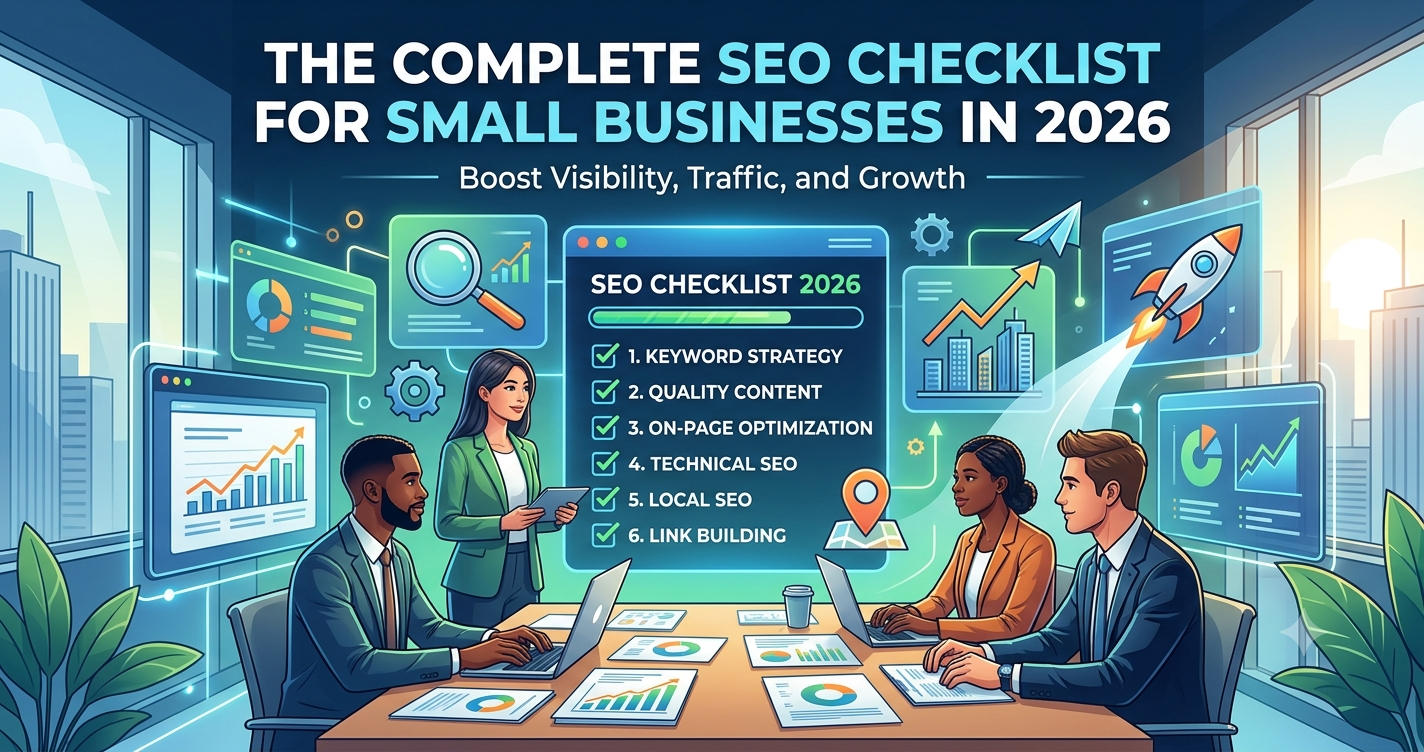
The Complete SEO Checklist for Small Businesses in 2026: A Practical Guide to Growing Your Business Online
Introduction
If you own a small business, you’ve probably heard the phrase “SEO is important.” But what does that actually mean for your business in 2026?
Search Engine Optimization (SEO) isn’t about tricking Google or stuffing your website with keywords anymore. It’s about creating a website that genuinely helps people find the information they need. When your website provides value, loads quickly, and answers your customers’ questions better than your competitors, Google rewards you with higher rankings.
Whether you’re a local business owner, freelancer, startup, or e-commerce brand, SEO is one of the most cost-effective ways to attract customers without paying for every click.
In this guide, you’ll learn a complete SEO checklist that covers everything you need to improve your website’s visibility in Google and attract more qualified visitors.
Why SEO Matters for Small Businesses in 2026
Today’s customers search online before making almost every purchase. Whether they’re looking for a nearby café, a digital marketing expert, or a clothing store, they start with Google.
A well-optimized website can help you:
– Increase organic website traffic
– Build trust and credibility
– Generate qualified leads
– Reduce dependence on paid advertising
– Improve long-term business growth
– Stay ahead of local competitors
The best part? Unlike paid ads, SEO continues working even when you’re not actively spending money.
1. Set Clear SEO Goals
Before optimizing anything, define what success looks like.
Ask yourself:
– Do I want more website traffic?
– Do I want more phone calls?
– Do I want more online sales?
– Do I want more local customers?
Your SEO strategy should support your business goals—not just increase visitor numbers.
2. Understand Your Target Audience
SEO begins with understanding your customers.
Think about:
– What problems are they trying to solve?
– What questions are they ask Google?
– Which words do they use?
– Are they searching locally?
When you know your audience, creating helpful content becomes much easier.
3. Perform Keyword Research
Keyword research is the foundation of SEO.
Instead of guessing, find the exact terms your customers are searching for.
Focus on:
– Primary keywords
– Long-tail keywords
– Local keywords
– Question-based keywords
Example:
Instead of targeting:
Digital Marketing
Target:
– Digital marketing freelancer
– SEO services for small businesses
– Affordable SEO expert
– Best digital marketing consultant
Long-tail keywords usually have less competition and higher conversion rates.
4. Optimize Every Page Title
Your title tag is often the first thing people see on Google.
A good title should:
– Include your primary keyword
– Stay under 60 characters
– Be easy to read
– Encourage clicks
Example:
Complete SEO Checklist for Small Businesses in 2026
5. Write Better Meta Descriptions
Your meta description influences whether people click your website.
Keep it:
– Around 150–160 characters
– Clear
– Action-oriented
– Keyword-rich
Example:
“Discover the complete SEO checklist for small businesses in 2026. Learn practical strategies to improve Google rankings and grow your business.”
6. Use Proper Heading Structure
Organize content using headings.
Structure:
H1 → Main Title
H2 → Main Sections
H3 → Subtopics
This improves readability for both users and search engines.
7. Create Helpful Content
Google rewards websites that genuinely help users.
Instead of writing for search engines, write for people.
Answer common questions.
Provide examples.
Share real experiences.
Offer practical solutions.
Helpful content always performs better than generic articles.
8. Optimize Images
Images improve user experience but should also be optimized.
Checklist:
- Compress images
- Use descriptive filenames
- Add alt text
- Use modern formats like WebP
Example:
Wrong:
IMG001.jpg
Correct:
seo-checklist-small-business.webp
9. Improve Website Speed
A slow website loses visitors.
Simple ways to improve speed:
- Compress images
- Use caching
- Remove unnecessary plugins
- Use quality hosting
Enable lazy loading
Fast websites improve rankings and user experience.
10. Make Your Website Mobile-Friendly
Most searches now happen on smartphones.
Your website should:
- Load quickly
- Have readable fonts
- Feature buttons that are easy to tap
- Adapt to different screen sizes
A responsive website is no longer optional—it’s essential.
11. Secure Your Website with HTTPS
Security builds trust.
Install an SSL certificate so your website uses HTTPS.
Visitors are more likely to trust secure websites, and Google considers HTTPS a ranking factor.
12. Build Internal Links
Every important page should connect naturally with other relevant pages.
For example:
Your SEO service page can link to:
- Google Ads Services
- Content Marketing
- Blog articles
- Contact page
Internal linking helps visitors and search engines navigate your site.
13. Earn Quality Backlinks
Backlinks remain one of Google’s strongest ranking signals.
Focus on earning links through:
- Guest blogging
- Business directories
- Industry partnerships
- Valuable content
- Case studies
Avoid buying backlinks or using spammy link-building tactics.
14. Optimize for Local SEO
If your business serves a local area, Local SEO is essential.
Complete your:
- Google Business Profile
- Business address
- Phone number
- Opening hours
- Customer reviews
Use consistent business information across all platforms.
15. Encourage Customer Reviews
Positive reviews improve trust and local rankings.
Ask satisfied customers to leave honest reviews on Google.
Respond professionally to every review, whether positive or negative.
16. Create High-Quality Blog Content
Publishing useful blogs helps attract more visitors.
Write about:
- Industry tips
- How-to guides
- Frequently asked questions
- Case studies
- Customer success stories
Fresh content signals that your website is active.
17. Improve User Experience (UX)
Google wants visitors to have a great experience.
Your website should:
- Be easy to navigate
- Have clear menus
- Include readable fonts
- Avoid excessive pop-ups
- Guide users naturally toward your services
A positive user experience increases engagement and conversions.
18. Track Your SEO Performance
You can’t improve what you don’t measure.
Use tools like:
- Google Search Console
- Google Analytics
- Google Business Profile Insights
Track:
- Organic traffic
- Keyword rankings
- Click-through rate
- Bounce rate
- Conversions
Review your performance monthly and refine your strategy
Common SEO Mistakes to Avoid
Even experienced website owners make mistakes.
Avoid:
- Keyword stuffing
- Duplicate content
- Broken links
- Slow-loading pages
- Ignoring mobile users
- Missing meta descriptions
- Publishing low-quality content
- Buying backlinks
- Forgetting image optimization
- Neglecting local SEO
Small improvements in these areas can have a significant impact over time.
SEO Trends to Watch in 2026
Search continues to evolve, and businesses that adapt early gain a competitive advantage.
Key trends include:
- AI-assisted search experiences
- Greater focus on helpful, experience-based content
- Voice search optimization
- Visual search improvements
- Stronger emphasis on page experience and Core Web Vitals
- Increased importance of topical authority over isolated keywords
Rather than chasing algorithms, focus on creating trustworthy, user-first content.
Your 2026 SEO Checklist at a Glance
Before publishing or updating any page, ask yourself:
- Is my target keyword included naturally?
- Does the title encourage clicks?
- Is the meta description compelling?
- Does the page answer the user’s question?
- Is the content original and useful?
- Are images optimized?
- Does the page load quickly?
- Is the website mobile-friendly?
- Are there internal links to related pages?
- Is there a clear call-to-action?
If you can answer “yes” to each point, you’re building a strong SEO foundation.
Final Thoughts from Anitha Venkatachalam
SEO isn’t about overnight success. It’s about consistently making your website more helpful, more trustworthy, and easier for both users and search engines to understand.
As a small business owner, you don’t need the biggest marketing budget to compete. You need a clear strategy, valuable content, and the patience to improve over time.
Start with the basics, measure your progress, and keep refining your website. Every optimized page, every helpful blog post, and every satisfied customer contributes to stronger search visibility.
Remember, the goal isn’t just to rank higher on Google—it’s to connect with the right people at the right time and turn visitors into loyal customers.